Many kinds of customer, one way of reaching out
Jaime joined Generac in September 2025 in a newly created role focused on automation and self-service within the CX team. Since then, the self-serve team has grown to span both Generac and ecobee, its sister company, with people split between the U.S. and Toronto.
Generac's customers are not one group. Owners of home standby generators, the permanently installed units that take over automatically when the grid goes down, are divided into two groups: DIYers who want to understand and service their unit themselves, and a much larger group who make a big one-time purchase and do not think about it again until a hurricane is 30 miles out. Then there is the portable line, for people who want power on the move. Before Mavenoid, nearly all of them reached out the same way: about 85% by phone, the rest by email, with a website chat tool that barely registered.
A storm forced the launch
Generac was midway through its plan to deploy Mavenoid when Winter Storm Fern hit at the end of January. Call volume in the support center spiked. Because Mavenoid could generate answers from Generac's existing content, the team decided they could go live early and take some of the pressure off the phone agents. The decision came on a Friday afternoon. The tool was live by Saturday morning.
Over the three days of the storm, around 1,800 people found the new tool on the website and gave it a try. It deflected calls. As Jaime put it, "we just kind of ripped the band-aid off." From there the team settled into a slower rhythm: review customer feedback, make tweaks, and add new triggers to get the tool in front of more people.
Replace the phone number, one touchpoint at a time
The biggest single win was auto-open. Instead of a small AI widget sitting in the corner of support.generac.com, Mavenoid now opens on page load. That one change increased usage by roughly 1,000%, and traffic has kept growing month over month because customers no longer have to notice a small orange button.
Auto-open did need one adjustment. In the mobile app, the tool opened over the entire screen, which got in the way of customers who had come from a Google search already knowing which article they wanted. So the team switched it off on those specific pages and kept it on everywhere else.
The second lever was email. Generac sends a number of standardized notification emails to owners, and the call to action used to be a phone number. Those CTAs now link into Mavenoid. Where the team knew a specific situation was coming, they worked with marketing to build a curated flow that walks customers through exactly what to do. The ongoing question is simple: where else is a phone number placed that could be a self-serve link instead?
The newest lever reaches people who have already picked up the phone. While waiting in the queue, callers are offered a text message with a link to the self-serve tool. Two weeks in, about 400 people had taken the option, and around 75% of them resolved their issue without an agent. It runs on one phone queue today, with more to follow as the results hold up.
Why deflection was the wrong metric
Generac originally built its ROI case on call deflection. The problem is that Generac is growing. Every unit sold adds another customer who might one day call, so phone volume can hold steady even while thousands of people use the tool. Deflection alone could not tell the story.
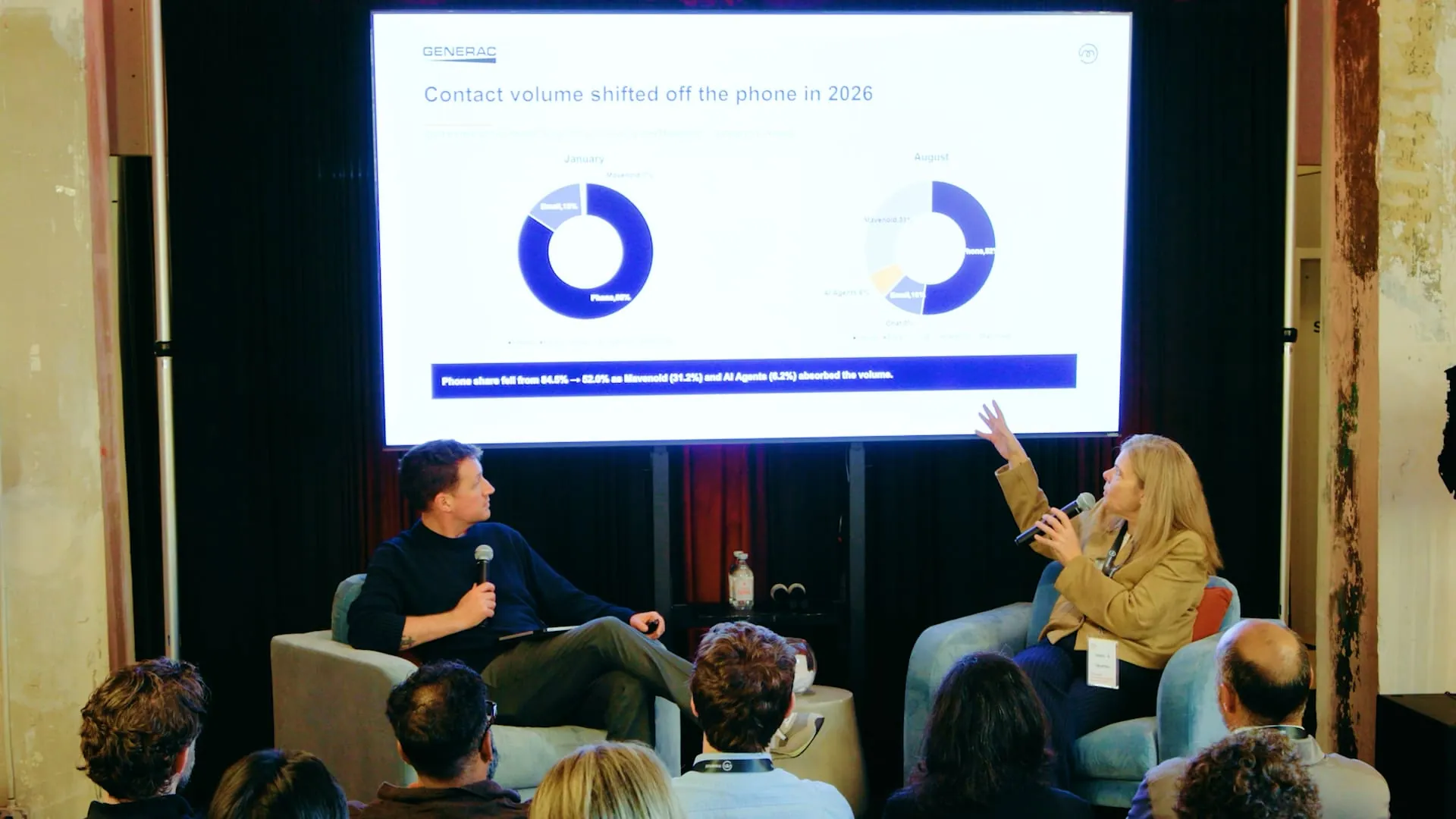
So the team switched to tracking contact mix: of everyone who reached out to Generac in a given month, which channel did they choose? In January, days after launch, it was 85% phone, about 15% email, and a sliver on Mavenoid. By August it was 52% phone, 10% email, 31% Mavenoid, and 6% through an AI voice agent handling one specific use case. Chat, which is still live, makes up less than 1%. The team attributes the drop in email to the CTA work and the drop in phone to Mavenoid usage itself.
Satisfaction held through every change
Moving from 85% phone to 52% in under a year is a fast adoption curve, and the team's guard against pushing too hard has been the satisfaction data. They review it regularly and check it every time a new trigger goes live. Positive ratings, as measured in Mavenoid's analytics, have stayed at around 93% through all of it.
One comment early in the rollout has stuck with Jaime and the team. A customer wrote, in summary, that this was one of the easiest support experiences they had ever had, and that they were 72 years old. For a customer base that skews older and is not always comfortable with technology, that was the signal the team had designed something that works.
Part of protecting that experience is knowing where self-service should stop. Generac's tool does not go near anything that could put a DIYer or their generator at risk. Those boundaries were approved by the legal team, and when a customer reaches one, the tool tells them to contact their local Generac dealer.
What's next
The strategy going forward is to keep finding touchpoints where self-service can be offered to more people. Voice is one: Generac already has an AI voice agent on one use case and does not want to fall behind there. Video is another. Many customers cannot tell what they own. It may be gray or cream, with or without a digital panel, and for portables, inverter or not. Letting a customer point their phone at the unit would make identification far easier.
Beyond support, the team is looking at generac.com itself and at pre-sales situations. And once Generac's agents move onto Salesforce Service Cloud, the handoff from self-service to a human can become specific to the use case, whether that means an agent, a chat, or a web form.