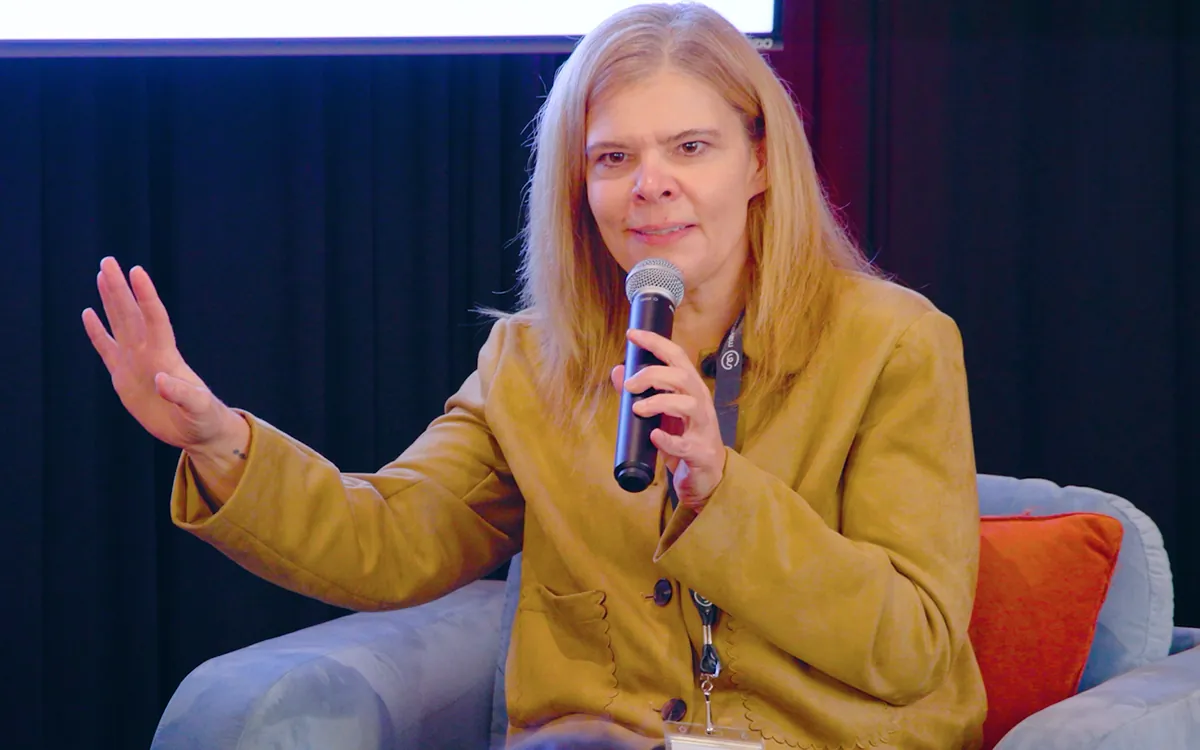
The session, hosted by Mavenoid's Joe Poupard, drew on six years of leading customer care at the Toronto-based smart thermostat maker. Andrée's job has been to operationalize ecobee's brand promise of "memorable care" at a company whose install base has grown a minimum of 25% year-over-year. By mid-2023, that scale demanded a new kind of support, and that is when ecobee partnered with Mavenoid.
The strategy: aim for impact
Everything at ecobee is organized around three customer journeys: pre-install, install, and post-install. Andrée has said this framework is how she explains support to the C-suite, and it drives every deployment decision. When ecobee started with Mavenoid, post-install accounted for 68% of all support contacts. That is the journey the team aimed at first.
Most teams launching AI pick off the simpler, lower-stakes problems and work up from there. Andrée went the other way. Using a complexity-versus-criticality matrix, she and her team prioritized high-criticality use cases first, where the impact on customers was greatest. "We needed to make a big impact fast. We were growing too fast as a company," she said.
Every early assumption was beaten
ecobee set a baseline solve-rate expectation of 25%. Mavenoid came in at 47% right out of the gate. Early satisfaction landed in the low 70s, which Andrée called "a very nice surprise." Today the tool pushes 89 to 90%, effectively matching human CSAT. "I didn't think people would use it," Andrée admitted. "Plain and simple."
One piece of groundwork made the fast launch possible. ecobee spent 2023 cleaning up its knowledge base, and that investment is why Mavenoid could go live quickly. Andrée's note for anyone starting today: no one should spend a year on a knowledge base now. Tools like Claude and Perplexity can template and translate in a fraction of the time.
The Wi-Fi story: AI revealed 30× hidden demand
ecobee had been handling around 2,000 Wi-Fi disconnect phone calls a month. A small cross-team tweak (renaming an in-app panel from "disconnected" to "reconnect your thermostat," and routing it into a Mavenoid flow) reshaped the numbers. Suddenly the team saw 2,000 users a day, roughly 60,000 a month, using the self-serve flow. The demand had been invisible until then.
Inside that single flow:
- Solve rate: 80%+
- Satisfaction rate: 90%+
The ratio that flipped three years early
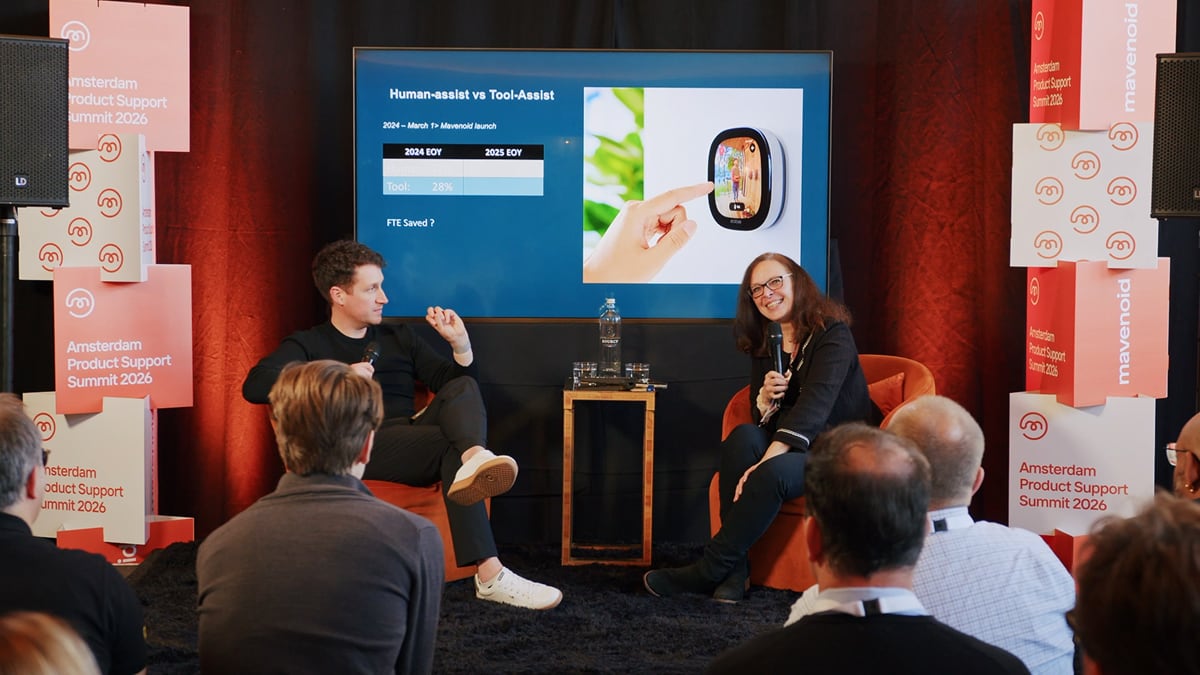
At the end of 2024, 72% of ecobee's contacts went to humans and 28% to the tool. The official 2028 goal was 65% tool / 35% human.
By the end of 2025, the ratio flipped, clearing the 2028 target in a single year. Today Mavenoid handles volume equivalent to 60 to 80 full-time agents, and the platform serves roughly 110,000 ecobee users every month.
The human element got stronger
A common worry with AI support is that it hollows out the human team. ecobee's data tells a different story. The company's brand promise is "memorable care," and Andrée has been deliberate about keeping humans on the calls where they matter most. Installation, the moment when a customer has just opened the box and wants to be comfortable immediately, goes to a priority phone queue. With Wi-Fi disconnections and other high-volume troubleshooting handled by Mavenoid, tier-1 agents now spend their time on harder, more complex issues, and the numbers have climbed.
ecobee's tier-1 training runs a minimum of three months, with six months to proficiency. That investment shows up in the feedback.
- Phone CSAT: consistently over 90%
- 40,000+ CSAT surveys a year, with roughly 80% including free-text comments
- The words customers use most often: patient, helpful, and knowledgeable
- ecobee's user guides, built through Mavenoid, carry a satisfaction rate that has never dropped below 95%
Because ecobee's average handle time runs around 20 minutes per call, every deflected interaction carries outsized impact. The tool frees agents to focus on exactly the conversations where human judgment matters most.
A framework worth stealing
A few principles Andrée kept coming back to:
- Know your numbers. Invent a baseline if you need to.
- Aim for impact. Easy wins can come later.
- Meet customers where they already are, in the app and at the moment of need.
- Don't demand identity up front if the use case doesn't require it. Friction kills adoption.
- Look at a thousand data points before drawing conclusions. Below that, the signal is not reliable enough to act on.
- Match the tool to the problem. Horizontal AI is strong, but at this point troubleshooting still takes depth of expertise. Use the knowledge base as guardrails for whatever AI you pick.