The Challenge
A regulated fleet, a shrinking team
Pursuant Health's Health Stations sit mostly in major retail pharmacy locations across the US, offering everything from free blood pressure checks to a retinal imaging screening that flags early signs of diabetic eye disease. Scott Robertson, the company's Chief Operating Officer, oversees the multiple teams responsible for keeping around 4,600 of these devices running: Customer Care, Technical Support, Field Service, Logistics, and Quality Management
When the COVID pandemic hit, Pursuant Health, like many other companies, faced significant business disruption and had to quickly adapt its operating model. At the same time, the mission didn’t change. Thousands of Health Stations had to stay online and fully operational in the field and every repair still had to meet strict requirements for how service was documented and validated. That meant finding a way to maintain the same high-level support with a leaner, more flexible cost structure.
Field repairs were stuck on paper
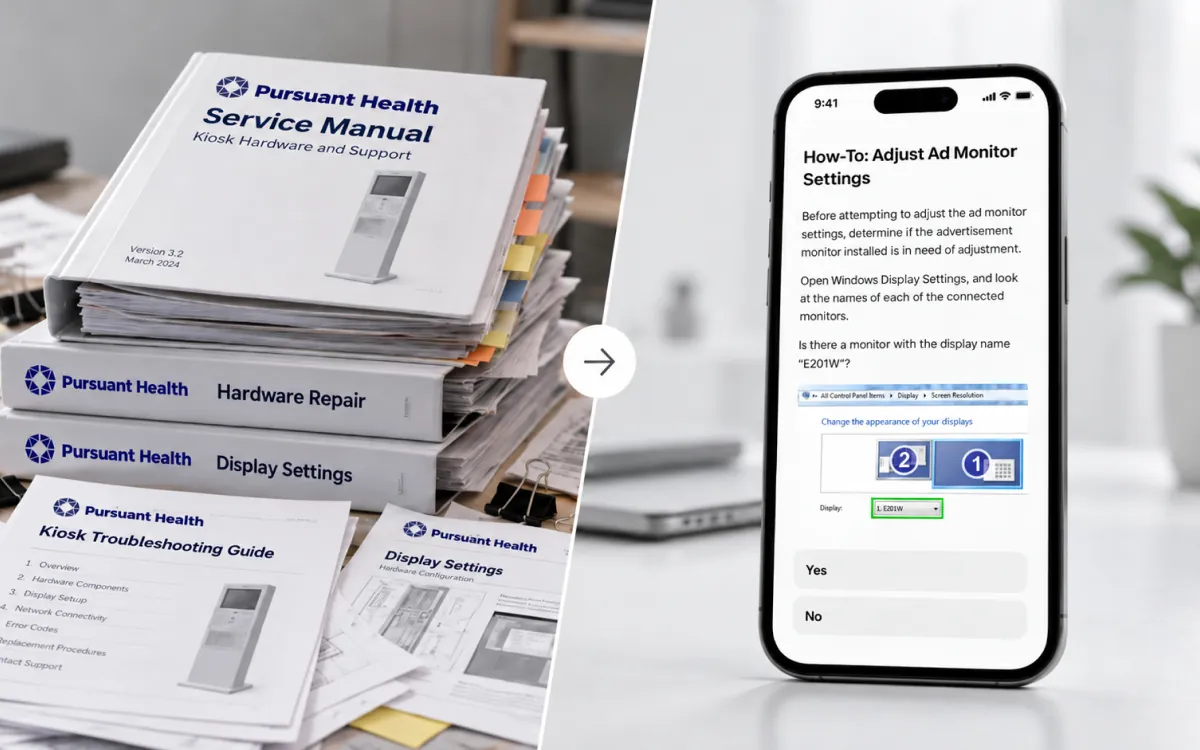
Every Health Station repair depended on a field technician following written instructions. Those instructions lived in PDF documents, and most technicians weren't reading them closely enough before starting a job. They'd get partway through a repair, hit a snag, and call tech support for help, which meant Scott's team was often talking someone through a fix step by step over the phone.
The team tried using video instructions to compliment the PDF documents, but full-repair walkthroughs ran 10 to 15 minutes, and technicians skimmed those too. What Scott needed was something that could break a repair into manageable steps and offer help exactly at the point a technician got stuck, without adding headcount to deliver it.
Why Mavenoid
Scott and his team evaluated several other options, but Mavenoid especially stood out for how easily non-technical staff could build and update flows themselves. That mattered for a small team without dedicated developers on hand.
Implementation
Scott and his Support Team Manager, led the rollout between them, and it went very smoothly. Implementation took place over 2-3 months with the team gradually rolling out the introduction of Manvenoid flows one field service repair at a time. They focused on their highest impact repairs first, eventually scaling all field repairs into Mavenoid. Today, Pursuant uses one large Mavenoid flow to cover all their field service repairs. When a work order goes out for a field repair for one of the Health Station’s components, it includes a deep link straight to that specific part of the flow. When a Technician arrives to perform the repair, they open it on their phones (they are on site, without their computers) and follow the guided steps. If they get stuck, they can reach out for help via chat.
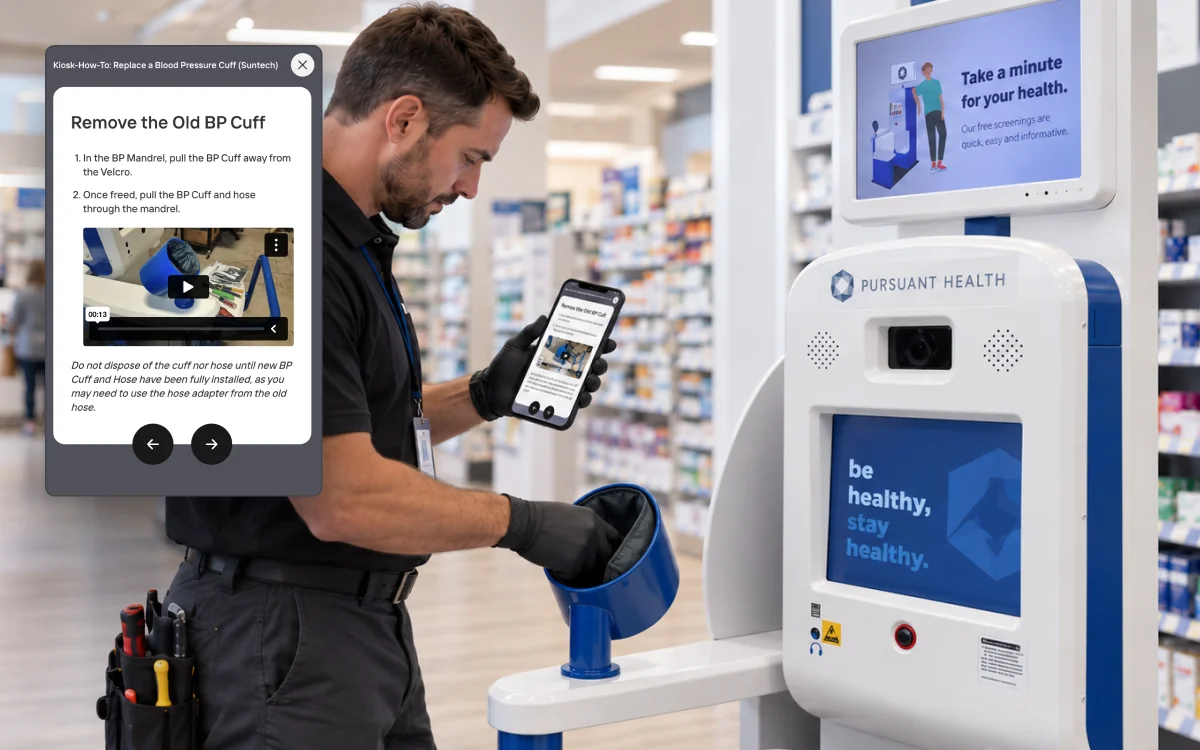
Because the Health Stations are regulated medical devices, every repair also ends with a verification and validation step. The flow walks technicians through a short check-out process, confirming what was done, before routing them to a support person for the release code they need to confirm the repair was made according to the instructions. That step can't be automated away, but everything leading up to it can.
Pursuant Health's Customer Care team uses Mavenoid too, through the Dynamic Help Center, a self-service portal Mavenoid built for them using their existing support documentation that surfaces content matched to a customer's specific issue, with chat available to launch from it whenever someone needs more than self-service can answer.