Eve Home
& Mavenoid

Smarter support through product identification and app personalization

Eve Systems is a smart home provider with a long history in Apple HomeKit and a leading role in pioneering Thread and Matter. The Eve ecosystem spans multiple generations of connected devices, each with its own connectivity, firmware, and troubleshooting profile. As new technologies arrived and the catalog grew, Eve's support team needed a way to keep pace without losing the premium, connected feel their customers expect.
Mavenoid's Impact
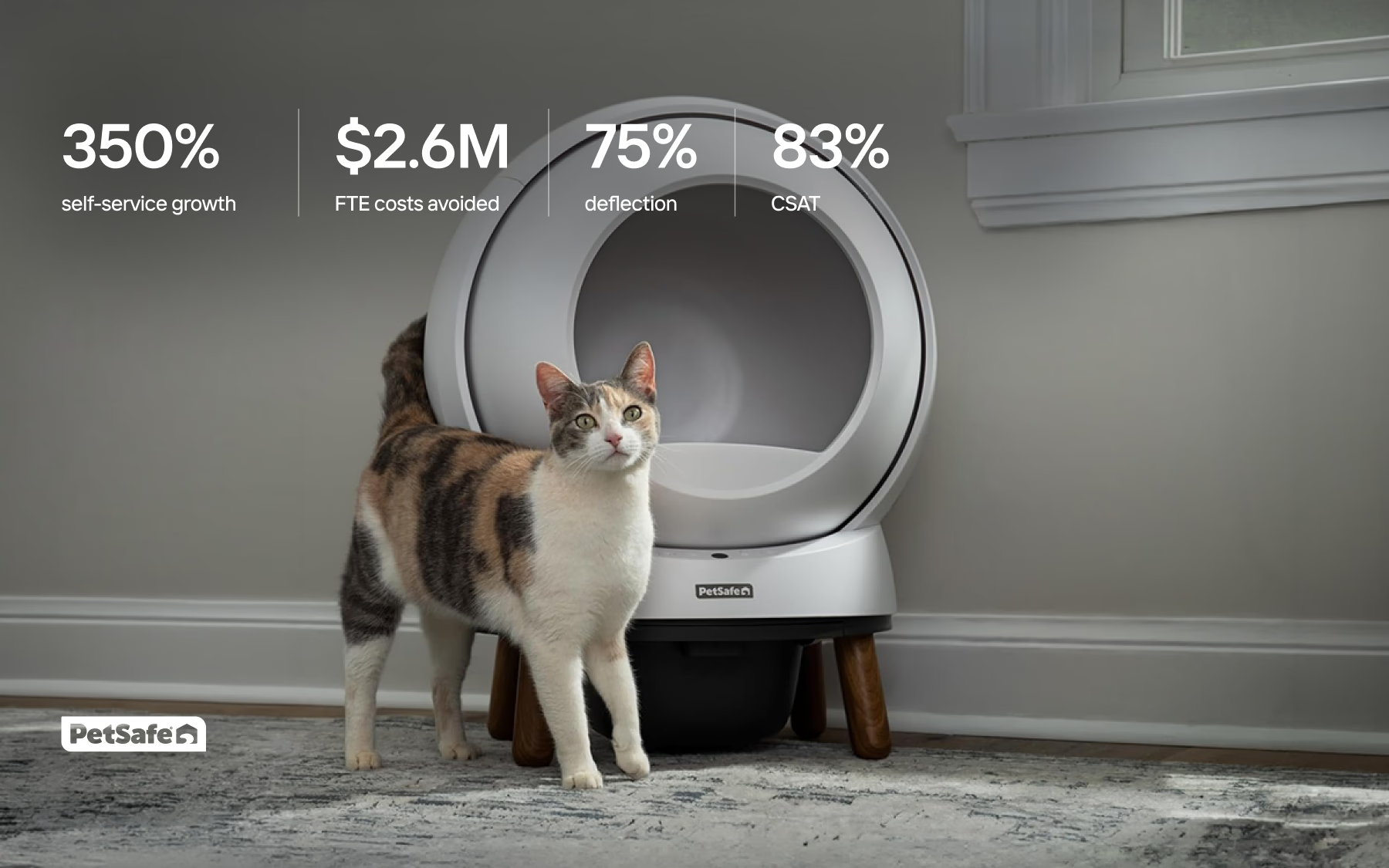
  • 75% self-service resolution
  • 50% ticket reduction YoY
  • 90% CSAT

The Challenge:

Before partnering with Mavenoid, Eve's technical support team operated in a reactive mode. The small team fielded every inbound request that wasn't tied to a specific department, like feature requests, how-to questions, and deep technical troubleshooting. As Eve launched new products and expanded into Matter and Thread, the volume and complexity of that workload grew quickly. Three main issues stood out:

1. Repetitive, manual FAQ work was eating up the team’s time

"We answered everything manually… it was pure copy-paste," says Ghania Ibelaidene, Technical Support Leader at Eve. With each new device generation, the FAQ surface expanded. Agents spent hours on questions that required no human judgment, leaving less capacity for the high-value technical cases that actually needed them. 

2. Product identification added 4-5 minutes to every case

Serial numbers tell Eve's team which device generation and connectivity a customer is running, which is essential context for any meaningful answer. But capturing that information was manual and slow. "Customer opens a case, first thing you do is ask for the serial number. So one interaction lost," Ghania explains. Multiply that by hundreds or thousands of cases and the cost compounds fast.

3. The support experience didn't match the product experience

Roughly 80% of support tickets came in via the Eve app, where customers expected a seamless, mobile-first interaction. Instead they had to leave the app, look up serial numbers, copy-paste them into web forms, and step through category selectors. "For a connected brand like Eve, asking users to leave the app to fill in a form just didn't make sense." There was no FAQ section or self-help in the app or on the website.

Behind all three was a more fundamental problem: Eve's systems (Zendesk, the Prodigy PIM, and the consumer app) lived in isolation. Every ticket required agents to switch tools, hunt for product information, and manually reconcile it against what the customer was describing. That broke the flow for customers and for agents alike.

"Mavenoid's flexibility meant we could adapt the system ourselves without waiting on requests. It made this feel like co-creation rather than configuration."
Ghania Ibelaidene
Technical Support Leader, Eve Systems

The Solution

Eve brought the challenge to Mavenoid, and within seven weeks the two teams had co-created a connected in-app and on-web support experience. 

Starting from proven patterns

Mavenoid drew on deployment patterns from other connected-device brands to shape requirements quickly. That meant Eve wasn't starting from scratch on questions like "how early do we identify the product?" or "what data should flow from the PIM?" because both sides already knew the shape of the answer.

A no-code platform Eve's team could drive themselves

The team was able to log into Mavenoid directly to design support journeys and test changes in real time, without waiting on engineering tickets or change cycles. "To have a partner who can actually integrate with no coding makes a big difference," Ghania notes. Weekly prototypes went to a steering committee every Friday, and leadership's reaction each week was some version of "I can't believe what you're doing" — the pace surprised even the people building it.

Deep integration between the systems that already held the answers

Mavenoid's flexible API connector tied together Prodigy (Eve's PIM), Zendesk, and the Eve app. With that backbone in place, Mavenoid could pull product data directly from Prodigy and use it to personalize the support flow without the customer having to look up a serial number or copy device details into a form. The built-in translation module handled multi-language content in the same pipeline, which Ghania described as "the cherry on the cake."

The Results

The impact showed up quickly, both in the numbers and in the shape of the work itself.

  • 75% of issues are now resolved through self-service. These are the questions Eve never hired people to answer in the first place (how many temperatures can I schedule, what does this feature do, which ecosystem does this device support). They now get resolved the moment the customer asks.
  • Tickets are down roughly 50% year over year. Ghania is careful to clarify that these were cases the team was handling that "didn't need any touching, because it's nothing that requires human intervention." Removing them has freed real capacity.
  • Customer satisfaction sits close to 90%. Much of the credit goes to the in-app experience: customers used to living on their phones can self-serve or open a ticket without ever switching to a computer.
Beyond the top-line numbers

The partnership has also reshaped how Eve operates and brought key learnings the team now carries into every new product launch.

Every conversation becomes data. Every Mavenoid conversation captures what customers looked for and what they tried to resolve it. Eve feeds that back into support content and uses it to flag gaps for marketing and sales.

Support has moved up the value chain. Mavenoid is now reviewed ahead of every product launch. A product can only exist in Mavenoid once it's properly documented in Prodigy, which has pulled support earlier into the product lifecycle.

Redefining what human support is for. With repetitive FAQs routed to self-service, agents now work on the harder cases like multi-hub troubleshooting and cross-ecosystem connectivity. Average handling time has risen as a result, which Ghania treats as a sign of deeper, higher-quality work.

Related customer stories